






The #1 Blocker to AI Isn't Budget. It's Your Calendar.

Hi all,
Two weeks ago I co-delivered a workshop for one of the largest pharma companies in the world. We polled the room on a simple question: what’s actually getting in the way of your AI transformation?
Not budget. Not tools. Not talent.
The number one answer: “I’m too busy with the day-to-day execution of my job to spend time on AI.”
I hear this everywhere I go, and I get it. Everyone has a day job. Nobody has a spare afternoon lying around.
But sit with the irony for a second. The thing that would give them their time back is the thing they can’t find time for.
It’s the credit card trap. You’re too strapped to pay down the balance, so you keep paying interest, which keeps you strapped. With AI, the balance is all the work you’re still doing the slow way.
There are no shortcuts, only reps
I’ve made the case here before that AI transformation is a fitness journey. No hacks, no magic bullets. You put in the reps or you don’t get the results.
Anyone who knows me knows my gym time is sacrosanct. Whatever else is happening in my life, at 5:00 I’m in the gym. It’s not negotiable, and I look forward to it all day.
So I ran the same experiment on AI.
AI Playtime: 9:00 to 10:30am
There’s now a second block on my calendar that gets the same protection. Mornings, when I’m fresh and full of ideas. With very few exceptions, from 9 to 10:30 you’ll find me building out an AI project or pushing on whatever tool just shipped.
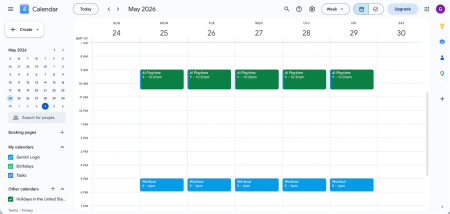
Not a webinar. Not a course. Building.
Google solved this 20 years ago
Their version was famous: 20% time. One day a week for employees to work on whatever interested them, as long as a manager approved it and it benefited the company.
Marissa Mayer, then a Google VP, said at the time that more than half of the company’s new product launches traced back to it. Gmail. Google News. AdSense.
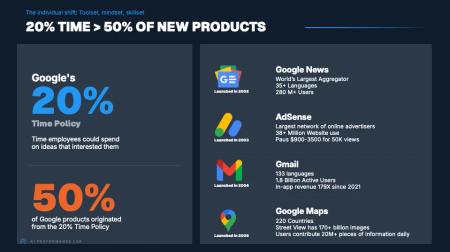
Here’s the part I find most instructive, though. Mayer later admitted 20% time was really “120% time” — most people did it on top of everything else. Which is exactly why most people never actually did it. Unprotected time isn’t time. It’s a good intention with a standing calendar conflict.
No magic transformations
A client asked us recently what the actual time commitment looks like to participate in the AI Performance Lab. Fair question. These are busy executives with real jobs, and I’d rather over-disclose up front than have someone discover it in week three.
So we sent them this:
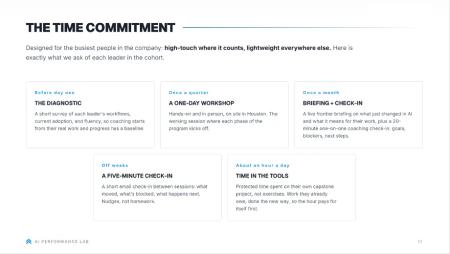
We design it to be high-touch where it counts and lightweight everywhere else. But the honest answer is still about an hour a day in the tools — on work they already owe, done the new way. There’s no version of this where the transformation happens and nobody spent the time.
Here’s my take
Nobody has ever won a race by refusing to pit. You surrender track position for twelve seconds so you can run the next forty laps on fresh tires.
Blocking this time will cost you productivity in the near term. That’s real, and I won’t pretend otherwise. But the leverage comes back at several multiples of the hours you gave up — just not on the same timeline you spent them. It’s an investment with a lag, which is precisely why it loses every fight against this week’s deadlines unless you defend it on the calendar.
What I’d do this week
Open your calendar. Find 90 minutejs. Make it recurring, and treat it the way you’d treat a client meeting you can’t move.
Then hit reply and tell me how you make time for this. I’m genuinely asking — I don’t think anyone has cracked this nut, and I’d like to know what’s actually working for people.
Best,
Dr. Michael “House” Housman